
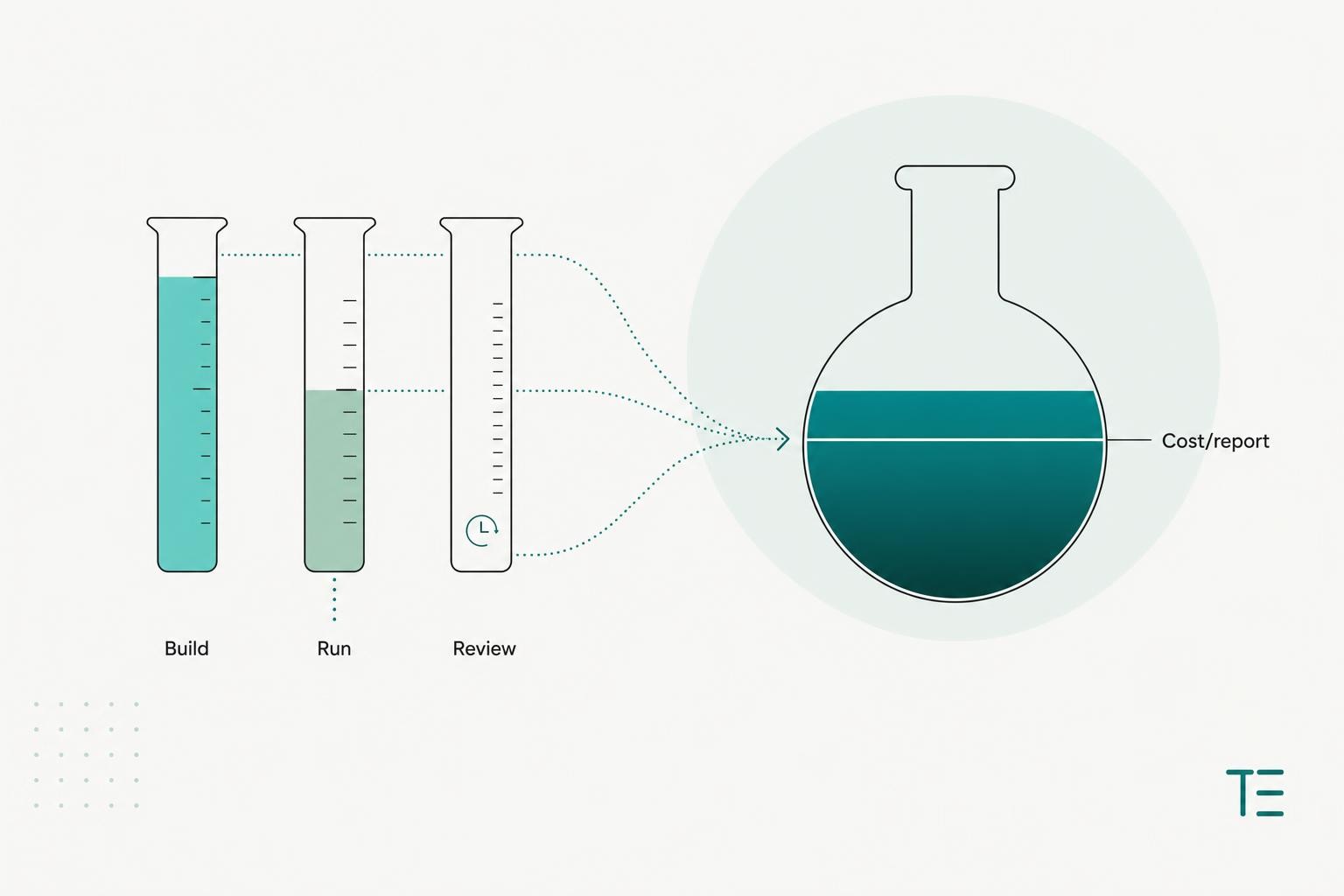
Take an example of what we could build: a client reporting system for a 25-account agency. In the example below, its software bill by month four is about $180 a month, the agency still spends about 26 hours a month reviewing output, and the one-time build fee is quoted after scoping.
Build, run and review are the whole argument about AI automation cost for marketing agencies. Most cost pages for this query give you a range from $99 a month to half a million dollars and never reconcile it. That happens because they price vendors. You buy workflows.
How much does AI automation cost for a marketing agency?
There are three tiers. A single DIY workflow on a cloud automation plan costs the plan fee plus a few dollars of model spend. A productized build done for you has a one-time build fee, quoted after scoping, then a monthly run cost for the platform, tokens and hosting. A multi-workflow system across 20-plus client accounts adds a retainer for monitoring and changes, also quoted after scoping.
Published ranges are useless because they mix a SaaS seat price with a custom engineering project. A $99 a month reporting tool and a $40,000 internal platform are not competing for the same money. One prices a template. The other prices your exceptions.
So the rule the rest of this post follows: price the workflow, not the tool. Build cost is one-time and negotiable. Run cost is forever.
One disambiguation before the numbers. This is not marketing automation platform pricing, which bills by contact count or seats. AI automation for marketing agencies means custom workflows and agents running on your own accounts. They are metered by execution volume, tokens and human review minutes.
What am I actually paying for in an AI automation quote?
Three meters, and they behave differently. Build is one-time. Run compounds monthly. Review is the one nobody puts in the quote, and in month one it is usually the biggest line.
Meter one: build
Discovery, workflow design, integrations, error handling, evals and handoff docs. Almost all of the setup fee sits here. A narrow workflow with one data source is the shortest build. A build stretches when there are four or more source systems, client-specific metric definitions, or more than one approval path.
Here is how that example build could overrun. Say it is scoped at a fixed fee and date. Then three larger accounts turn out to have custom definitions for qualified lead, blended CPA and assisted organic conversion, buried in old Looker Studio formulas. That alone can push it past its date.
Genuinely new scope, like a second approval path or a custom export format, should be a change order. The rest is the builder's risk. That is why we ask for three real past reports, the raw source dashboards and a written list of client-specific metric definitions before we quote.
Meter two: run
Platform executions, model tokens, hosting, logging, and a small monthly change budget for when a client platform shifts its API. Here is the example budget for that reporting build.
| Line item | Month one | Month four |
|---|---|---|
| n8n platform plan | about $65 | about $65 |
| LLM token spend | $78 | $46 |
| Hosting and database | $52 | $52 |
| Monitoring and logging | $18 | $18 |
| Human review | 68 hours | 26 hours |
| Review cost at $55/hour | $3,740 | $1,430 |
Read the review line first. In this example, month-one software is $213 and month-one review is $3,740, about 18 times the software bill. Review stays high on purpose in month one, so account managers can grade AI drafts against their old manual reports. The full multi-client reporting agent build is written up separately.
Four red flags in any quote you receive: no error budget, no ownership clause, no named monthly run estimate, and token cost described as negligible.
What do the workflows agencies automate first actually cost?
The five workflows agencies usually automate first are multi-client reporting, lead qualification and routing, ad copy variants, SEO briefs and onboarding intake. What each costs depends on your volumes and review time, so run the numbers with your own inputs.
The formula is one line:
cost per deliverable = (monthly run cost + review hours x loaded hourly rate + amortized build) / monthly deliverables
Run it on the example reporting build. Month four would be about $181 in software and tokens, plus 26 review hours at $55, so $1,611 for 25 reports. That is about $64 per report before the build. Spread the build fee from your quote over 12 months and add it to each report to get the first-year all-in number. That figure survives a partner meeting, because your team already knows what you bill for a monthly report.
Reporting costs the most to build because every client has slightly different metrics, even when the agency swears the template is standard. Client reporting automation is still the highest-volume target for most agencies. Lead qualification and routing is the cheapest place to start.
Zapier vs n8n vs a custom build: which is cheaper for my workflow shape?
The answer depends almost entirely on how many steps your workflow has, because the two platforms meter differently. n8n counts one execution per full workflow run, no matter how many steps are inside it. Zapier meters per successfully completed action step, with triggers and filters free. So a 10-node workflow run 1,000 times is 1,000 n8n executions but around 9,000 Zapier tasks.
Self-hosting is where the free myth lives. I tell agencies to self-host when execution volume is high, data control matters, or custom code needs to sit next to the automation layer. Self-hosting still costs compute, backups, monitoring and a block of maintenance hours each month, so price those before you call it free.
A custom build only beats both platforms when you have real volume, a client-facing interface, data you must own, or logic the platform would charge you per step to express. Those thresholds are covered in our post on whether to build or buy your AI marketing agent.
How much do the tokens cost on top of the platform fee?
Less than agency owners fear, and in a shape most people guess wrong. Long prompts are not the killer. Long outputs are. On OpenAI's published API pricing as of writing, GPT-5 bills $1.25 per million input tokens, $10 per million output tokens and $0.125 per million cached input tokens. API billing also runs on prepaid credits with no subscription ceiling.
My routing rule is cheap model for structure, expensive model for judgment. Anything that extracts, labels, dedupes, routes or checks a threshold runs on the cheap tier. Anything a client might read, challenge or use for strategy gets the stronger model.
Because there is no plan ceiling, a runaway loop is a budget event rather than an error message. On day one of a build we set a separate API key per workflow, prepaid credits with a small balance, and usage alerts at 50, 75 and 90 percent. We also add five controls in code.
- A hard monthly budget checked before every model call
- Max retries of 2 or 3
- An hourly execution cap per workflow
- Output length limits on every prompt
- A kill switch anyone on the team can flip
What is the chance I spend the money and get nothing?
Higher than any vendor will tell you. In McKinsey's 2025 survey, 80 percent of respondents say efficiency is an objective of their AI work, but only 39 percent report EBIT impact at the enterprise level.
I look for four things before I expect a workflow to keep running: one named person owns it after launch, it has a measurable target such as reporting hours under 10 a week, review time is budgeted as part of unit cost, and it lives inside the existing stack instead of a new portal.
When not to automate yet
I tell agencies to wait when the workflow saves less than 15 to 20 hours a month, changes more than once a month, or carries more than about 25 percent exception handling. A workflow that saves 6 hours a month is $330 of labor at $55 an hour, so most builds pay back too slowly unless they create revenue.
Should I bill clients for the tokens, absorb them, or mark them up?
Do not put tokens on an invoice as a line item. Clients buy reports, briefs and faster follow-up. Price the output and bury the token cost in your delivery math.
| Model | When I recommend it |
|---|---|
| Absorb into the retainer | Low token spend, healthy retainer margin, no client-facing AI product |
| Pass through at cost plus a platform fee | Enterprise client, transparent ops agreement, volatile usage |
| Productize per deliverable | Repeatable workflow, client-visible output, predictable unit cost |
My resell test: all-in cost per deliverable should be under roughly one third of what you charge for that deliverable.
Reselling only works if you own the asset. Under our agreements, the code we write for you, your prompts, rules and data belong to you, the agreement lists any third-party or licensed components, and you hold the API keys from day one. If you plan to resell, make sure that is written down, or that you have a clear white-label AI development license.
Where to start this week
Pick the workflow with the highest monthly volume times minutes per unit. For most 10 to 50 person agencies that is client reporting or inbound lead follow-up.
Then run the formula with four of your own inputs: monthly volume, review minutes per unit, loaded hourly rate and platform executions per run. If the result is under about $800 a month of labor, do it yourself on a starter automation plan and prove the process first. Over that, scope a fixed-scope AI sprint with one agreed KPI.
If you have one quarter, spend it on one workflow in this order: a workflow audit and KPI definition, a fixed-scope MVP for one client or one pipeline, the production build, and the tuning pass everyone forgets. Platform, tokens and hosting start billing at the MVP.
Judge it after the second full cycle, not the first. My payback target is under 90 days for labor-saving workflows, and faster for anything tied to speed-to-lead.
If you want a second opinion on which workflow to price first, book a free intro call.
Frequently asked questions
Who owns the automations if I stop working with the agency that built them?
Whatever your contract says, so read it before you sign. Under our agreements, the code we write for you, your prompts, rules and data belong to you, the agreement lists any third-party or licensed components, and vendor accounts and API keys are yours from day one. When an engagement ends we confirm your admin access and rotate any temporary credentials we held.
Can I just build this myself in n8n or Zapier without hiring anyone?
For a narrow workflow, yes, and I will tell you to. A form-to-CRM qualifier with a Slack queue is a weekend of work for a technical ops person on a starter plan. It stops being a DIY job when you need enrichment from paid APIs, CRM deduplication across pipelines, assignment rules and reporting in the same system.
How long does a first AI automation build take from kickoff to production?
It depends on the number of source systems, metric definitions and approval paths, and you get a date after scoping. Reporting builds run longer, and the thing that stretches them is almost always client-specific metric definitions rather than the AI itself.
Should I pay a fixed project fee or a monthly retainer?
Fixed fee for the build, small retainer for the run. Fixed price forces both sides to define scope, which is exactly where reporting projects go wrong. The retainer should cover monitoring, API breakages at client platforms and a couple of hours of changes a month, not open-ended new features.
How do I know the AI output is as good as what my team produced?
Define one quality check before the build starts, then compare side by side for the first full cycle. In the example reporting budget, month one carries 68 review hours so account managers can grade AI drafts against the manual versions. If review time is not falling by month three, the workflow is not finished.